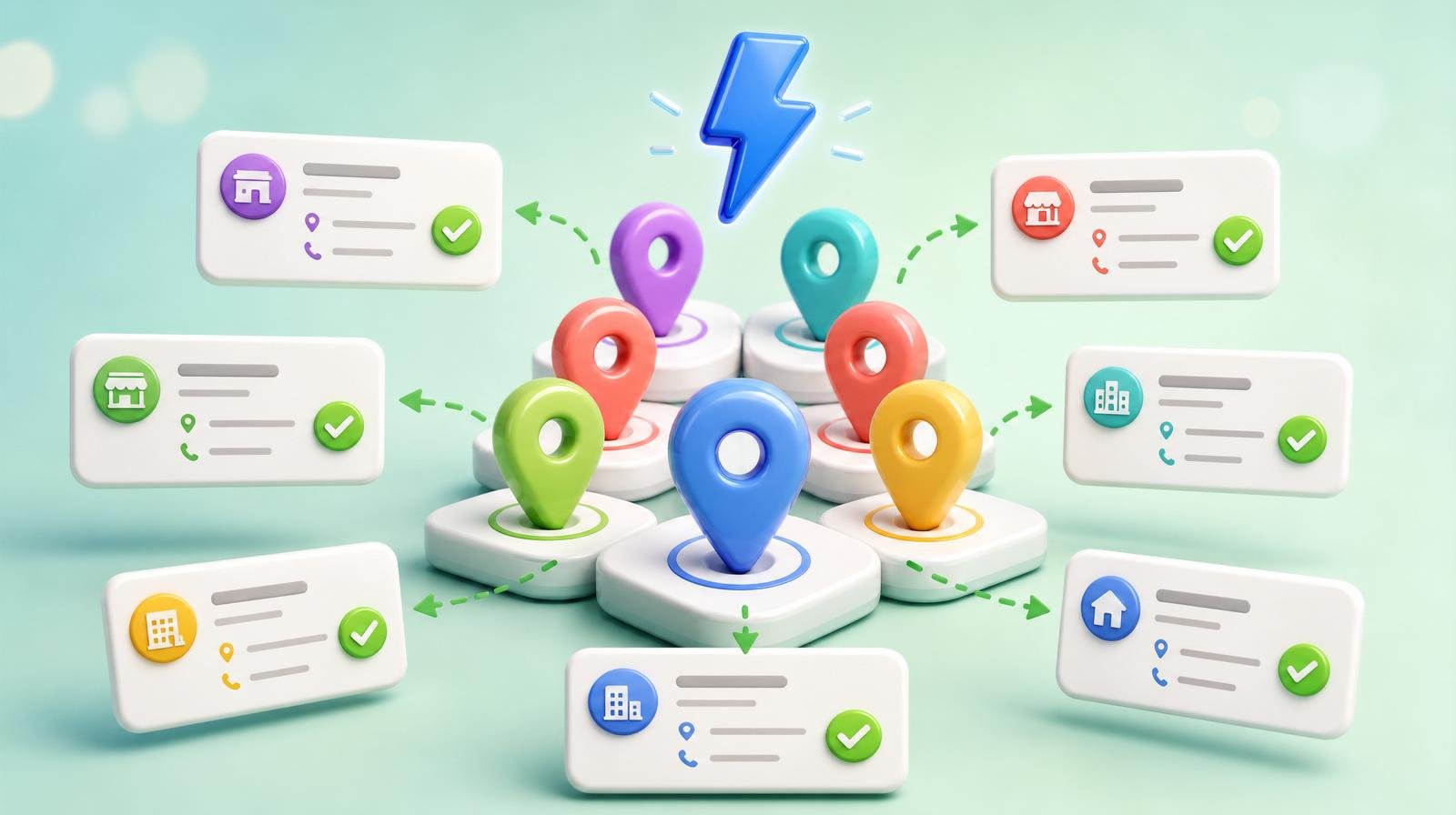
Local citation building is the process of getting your business's Name, Address, and Phone number (NAP) listed consistently across trusted directories so Google trusts you enough to show you in the local 3-pack. In 2026 you don't need 300 citations — you need 30–50 clean, consistent ones on the sites that actually matter. Here's exactly which sites, in what order, and how to do it in under a day.
What "local citation building" actually means
A local citation is any online mention of your business's NAP data — usually on a directory (Yelp, Apple Maps, Bing Places), but also on association pages, chamber-of-commerce sites, and industry-specific databases. Google uses those mentions as trust signals: the more places your correct NAP appears, the more confident Google is that you're a real business at that real address. That confidence feeds directly into local pack rankings, along with proximity, reviews, and on-page signals.
Whitespark's Local Search Ranking Factors study has ranked citation signals in the top 10 local ranking factors every year since 2013, and 2026 is no exception. Whathas changed is the emphasis: quality and consistency now dominate over raw quantity.
The 4-step citation build order (the pros use this)
Follow this order — skipping ahead wastes weeks
- Lock down NAP — one canonical version, everywhere
- Claim the Big 4 (Google, Apple, Bing, Facebook)
- Fill tier-two directories (Yelp, YP, Foursquare, Nextdoor)
- Layer industry + geo-specific citations
Fix consistency first, then add authority, then add relevance. Most guides tell you to do steps 3 and 4 first — don't.
Step 1: Lock down your NAP before you build anything
Open a doc. Write out the exact version of your business name, address (with correct suite/unit abbreviation), phone number, and website URL you're going to use everywhere. Then audit every listing you already have — Google, Facebook, Yelp, Bing, Apple, your website footer, your email signature — and fix any that don't match. Even small differences ("Suite 101" vs "Ste. 101" vs "#101") create trust penalties in Google's algorithm.
For a deeper walkthrough of the format rules, see our NAP citations guide — it's the fastest way to spot mismatches before you make them worse by broadcasting them to 50 new sites.
Step 2: Claim the Big 4
These four platforms drive roughly 90% of citation-based local ranking value. If you only build citations here and nowhere else, you'll still outrank most of your competitors.
- Google Business Profile — the single most important listing on the internet for local businesses. Our GBP setup guide walks through it.
- Apple Business Connect — powers Apple Maps, Siri, and Spotlight. Free, and roughly 30% of US smartphone users default to Apple Maps.
- Bing Places — feeds Bing, Yahoo, DuckDuckGo, and ChatGPT's live web-browsing tool. Small but growing.
- Facebook — still the second-largest local discovery surface after Google, especially for restaurants, service businesses, and events.

Step 3: Fill tier-two directories
Once the Big 4 are clean, add these next. All are free, all are worth claiming, and Google reads all of them:
- Yelp
- Yellow Pages (YP.com)
- Foursquare / Factual (feeds Snapchat, Uber, many apps)
- Nextdoor Business
- MapQuest
- Better Business Bureau (BBB)
- Superpages
- Hotfrog
For a full walkthrough of which sites your industry needs beyond these, see our business listing management guide.
Step 4: Add industry and geo-specific citations
This is where relevance kicks in. Restaurants need OpenTable, Grubhub, TripAdvisor, and Zagat. Contractors need Angi, HomeAdvisor, Houzz, and Thumbtack. Lawyers need Avvo, FindLaw, Justia, and Martindale. Every industry has 5–15 databases Google associates with that vertical — and being on them tells Google what you actually do.
Geo-specific citations matter too: your local chamber of commerce, city business directory, and any regional "best of" publications. These are usually the highest-authority links you'll ever get for local SEO.
Free vs paid citation building — which should you use?
Manual, free citation building works — it just eats 20–40 hours of your time, and every time you change your phone number or address, you get to do it all over again. Paid tools push your data to 60–100+ sites in minutes and monitor the listings for changes, mismatches, and duplicates.
Listings AI submits your NAP to 70+ directories in one click, auto-detects data mismatches on the sites that matter, and keeps everything synced when you change your hours or move locations. Run a free scan on your existing listings before you decide either way — you can try a listings scan here, or compare plans on the pricing page.
The 5 citation mistakes that quietly cost you rankings
- Chasing volume over consistency. 40 clean citations beats 400 mismatched ones every time.
- Different phone numbers on different sites. Tracking numbers on Yelp but your real number on Google creates the exact inconsistency Google penalizes.
- Duplicate listings. Two Google Business Profiles at the same address will actively split your ranking authority. Merge them.
- Ignoring industry directories. The niche-specific ones are usually the fastest ranking wins.
- Never re-auditing. Directories go stale. Re-check your top 30 every 6 months.
What to do this week
- Write out your canonical NAP and audit your top 10 existing listings against it.
- Claim or optimize the Big 4 — Google, Apple, Bing, Facebook — in that order.
- Run a listings scan to see which of the tier-two and industry directories you're missing, then either build them by hand or push them out in one click.
For the ongoing management piece — monitoring, fixing, keeping everything in sync as your business changes — see our business listing management playbook.